
Here is an audio recording of how I think I have met the learning outcomes for this course. I attempted to use Garage Band to record the audio and create an audio file however, it was very much a struggle for me to get the app to work properly on my computer. Maybe I can set that as a goal for a future project is use an application to get an audio file.
Category: Free Inquiry
This is the category to apply to your Free Inquiry posts.
This week I was at home for reading break and thought I would take the opportunity to tell my family about my inquiry project. I decided to sit them down and teach them all how to sign their names using the ASL alphabet. We created this video to show what they had learned. We spent our dinner passing around the ASL alphabet paper learning how to sign each others names. This was a great time to connect school with my personal life and have some good laughs. Lets just say even though this is a very simple sign language activity they all struggled and we did have to take a few retakes…
Here is the URL to the website that showed us each letter in the ASL alphabet. Link: https://www.lingvano.com/asl/blog/sign-language-alphabet
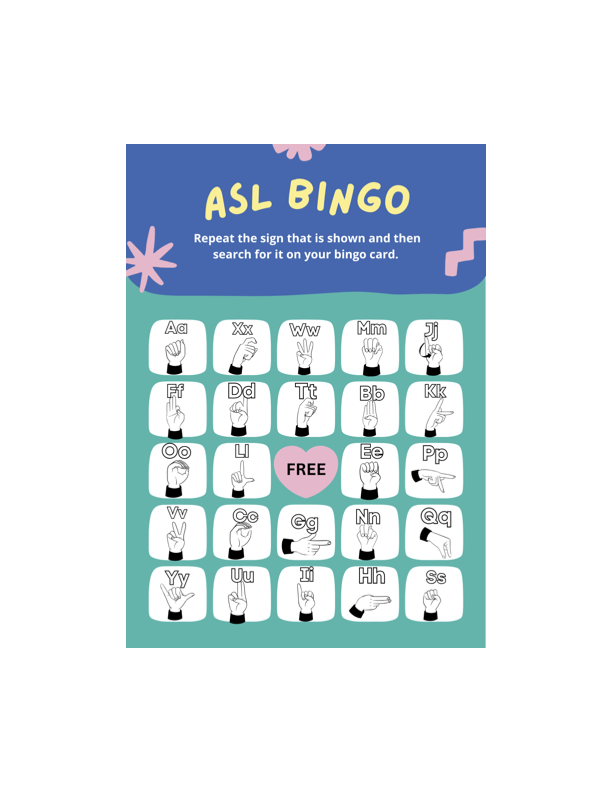
This week, for my inquiry project, I decided to take the opportunity to bring something I had previously created in this course into a real classroom setting. Earlier in the semester, we were asked to create a project using some form of media. My group decided to use Canva to create an ASL Bingo game. During my Link 2 Practice this week, I thought it would be a great opportunity to try out our game with my Grade 6 class. At the beginning of our time at the school, our host teacher let us know that if we had any activities or ideas we wanted to try with the students, we were more than welcome to do so.
I decided to introduce our ASL Bingo game, and the students absolutely loved it! What I found especially interesting was that even after the game was finished, many students continued showing an interest in learning different words and names in sign language. Our Bingo cards focused specifically on the ASL alphabet, which encouraged students to learn how to fingerspell their own names. By the end of the block, almost every student knew how to sign their first name, and many were asking how to spell their last names as well. This is such a great and simple way to integrate ASL into the classroom while creating a low-pressure environment where students feel comfortable learning and trying something new.
Before introducing the activity, I had to make a few adjustments to our original Bingo cards. I realized that not every card could be the same, and since I couldn’t fit all 26 letters onto each card, some cards contained letters that others did not. I also used an online Bingo number generator and modified how I called out the letters so that it worked with the ASL alphabet while still making the game feel like an official Bingo game.
I chose not to take any pictures during the activity, as some students preferred not to be photographed, and I wanted to respect their privacy and wishes. Although I would have loved to capture some moments from the activity since the students enjoyed it so much. Overall, I found this to be a really rewarding experience. It was exciting to see something my group had created for a university assignment actually being used in a classroom. I was especially happy to see how engaged the students were and how the activity encouraged them to continue learning even after the game had ended. This experience reminded me that learning does not always have to involve traditional lessons or worksheets. Sometimes, a simple game can spark curiosity and encourage them to explore something new on their own. It also connected to my own inquiry project, as I was able to practise my ASL skills while introducing students to a language that I have been learning myself. As a future teacher, I hope to continue creating activities that incorporate ASL. I think that once students have a basic understanding of American Sign Language, it can become easier to integrate it into everyday classroom routines. For example, students could use simple signs to ask questions, request permission to leave the classroom, or communicate basic needs. This would be a great way to encourage students to continue practising ASL naturally throughout the school day while building on what they have already learned.
Here is one of the ASL bingo cards:
For this week’s reflection, I decided to take the opportunity to review how I am getting my learning done, rather than just focusing on showing my learning progress. I think this is an aspect of learning that often gets forgotten, but it is important to recognize the different strategies and resources that help me reach my goals.
For my daily practice, I have been using an app called ASL Bloom. This app works similarly to Duolingo, where you learn the basics of sign language through repetition and practice until the signs become more familiar and easier to remember. I have found this especially helpful for building my basic vocabulary and continuing to practice what I have already learned.
For learning more specific words, I decided to use the ASL Dictionary (https://www.handspeak.com/word/). This website is a really cool resource because you can search almost any word, and a video will appear demonstrating how to correctly sign it. I have been able to learn the words on my Trello planner that I will use as a future teacher in my classroom routines. I also appreciate being able to watch the videos multiple times to better understand the hand movements.
Another learning strategy I decided to explore was social media. I am someone who enjoys spending time scrolling through social media, so I thought this could be a great opportunity to learn ASL while doing something I already enjoy. I was able to find a few creators who have Deaf family members and create their content entirely in sign language with subtitles. This has been a great way to observe how sign language is used in everyday conversations rather than just learning individual words. It has also allowed me to continue absorbing the basics while becoming more familiar with how people communicate through ASL.
In terms of my current learning outcomes, I feel that I have developed a stronger understanding of basic ASL vocabulary and am becoming more confident recognizing and remembering different signs. I am beginning to notice that I can recognize certain words when watching others sign, which is exciting because it shows me that my daily practice is paying off. However, I still find it challenging to remember signs without having a visual reminder, and I sometimes need to slow down videos to understand what is being communicated.
Over the next few weeks, as we finish the course, I hope to continue building my vocabulary while focusing more on putting individual signs together to form simple sentences. My goal is to become more comfortable introducing myself, asking basic questions, and participating in short conversations using ASL. I also want to improve my ability to recognize signs without relying as heavily on subtitles or demonstrations.
Overall, this week reminded me that learning does not always have to happen through traditional studying. By finding different ways to incorporate ASL into my daily routine, I have been able to make my learning more enjoyable and accessible. I am excited to continue to find more resources that support my project.

Here is my video for my second week of learning ASL. This video shows the vocabulary I focused on learning this week. Once I get the basics down I will be able to start combining my learning to communicate full sentences in sign language.
Link for the video: https://edci336lilygaudreau.opened.ca/wp-content/uploads/sites/10766/2026/10/Learning-ASL-WEEK-2-.mp4

Here is my week one update! This week I wanted to focus on the basic and everyday words. I really enjoyed spending some time learning ASL this week. I found it was an opportunity for me to take a break while still being productive and spending time doing something I am passionate about. If the sound doesn’t work please press on the link attached to the video. This should bring you to a new page where the sound will work (hopefully).
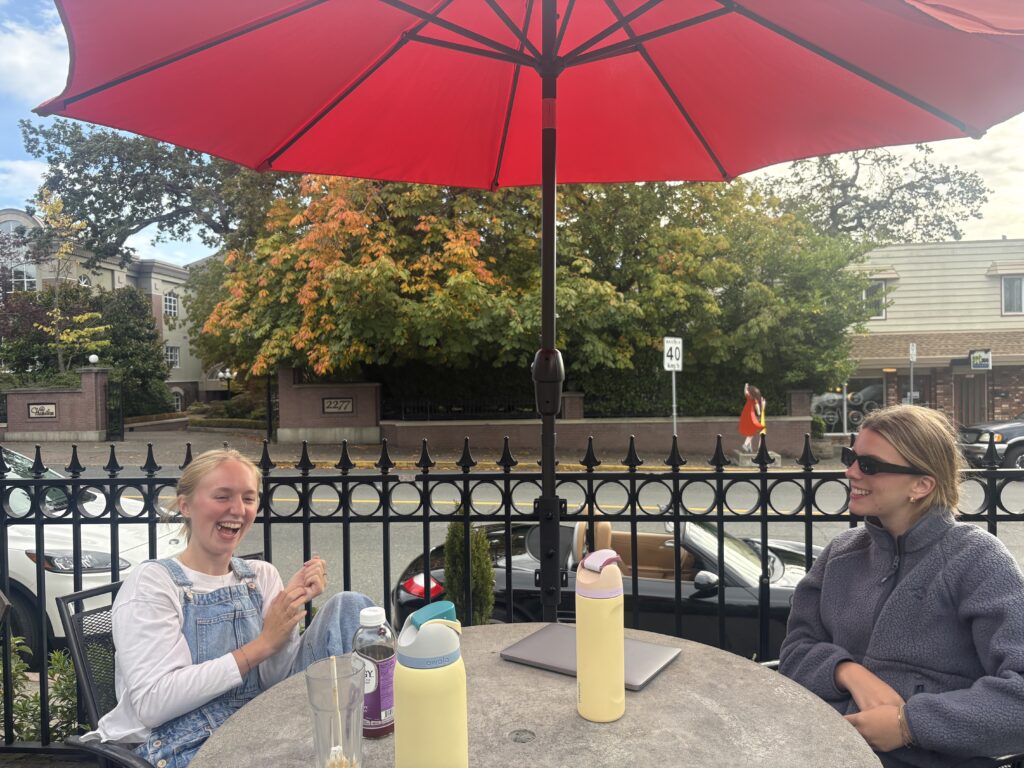
Today, I had the opportunity to meet with a friend who is so skilled in ASL, and it was such a great experience to practice together. We spent the afternoon at a cafe in Oak Bay, learning and working through some new words and sentences. It was really helpful to have someone to practice with, and I enjoyed being able to learn while also spending time in the sun. I’m grateful for the time we spent together and excited to keep building my ASL skills!
https://trello.com/b/GNyAz1ad/my-trello-board
Today, I created a planner on Trello to help me stay on track with my ASL learning and keep everything organized. I have created a list of words that I plan to learn each week, and I will document my progress by creating videos.
By the end of the semester, I hope to use everything I have learned to sign an entire children’s book and a children’s song. I will also create and demonstrate an entire classroom routine using ASL.
I chose vocabulary that I will be able to incorporate into my future classroom and use in everyday classroom routines. I want this experience to be practical and meaningful as I prepare to become an elementary teacher.
Trello was surprisingly easy to set up and use, and I’m excited to see how it helps me stay organized throughout this learning journey!
When we were first asked to choose an inquiry project for this course, I knew right away what I wanted to focus on. We were encouraged to pick something we were passionate about. This was a simple decision for me, I want to learn basic American Sign Language (ASL).
As a future teacher, learning ASL has always been something I have wanted to pursue. I think that incorporating sign language into the classroom can help create a more inclusive and welcoming learning environment. I also think that having a basic understanding of ASL could be a valuable skill for all teachers. Even simple signs, such as asking to use the washroom or get a drink of water, can help make classroom transitions smoother and reduce interruptions during learning.
I have always wanted to learn ASL, but I have never devoted enough time to actually committing to it. Choosing this as my inquiry project will give me the encouragement and accountability I need to finally make learning sign language a priority.
Through this project, I hope to develop the basic foundations of ASL and learn practical signs and phrases that I can eventually incorporate into my own classroom. Each week I plan to update my website by showing a video of the new vocabulary I learned. I have created a chart with learning goals and what I hope to achieve each week. I can’t wait until the end of the course to look back and see all the progress I have made. More importantly, I hope this experience will help me become a more inclusive and thoughtful educator.
More importantly, I hope this experience will help me become a more inclusive and thoughtful teacher.
This is where you share your updates and creations for Assignment 1: Free Inquiry Project.