
This week, for my inquiry project, I decided to take the opportunity to bring something I had previously created in this course into a real classroom setting. Earlier in the semester, we were asked to create a project using some form of media. My group decided to use Canva to create an ASL Bingo game. During my Link 2 Practice this week, I thought it would be a great opportunity to try out our game with my Grade 6 class. At the beginning of our time at the school, our host teacher let us know that if we had any activities or ideas we wanted to try with the students, we were more than welcome to do so.
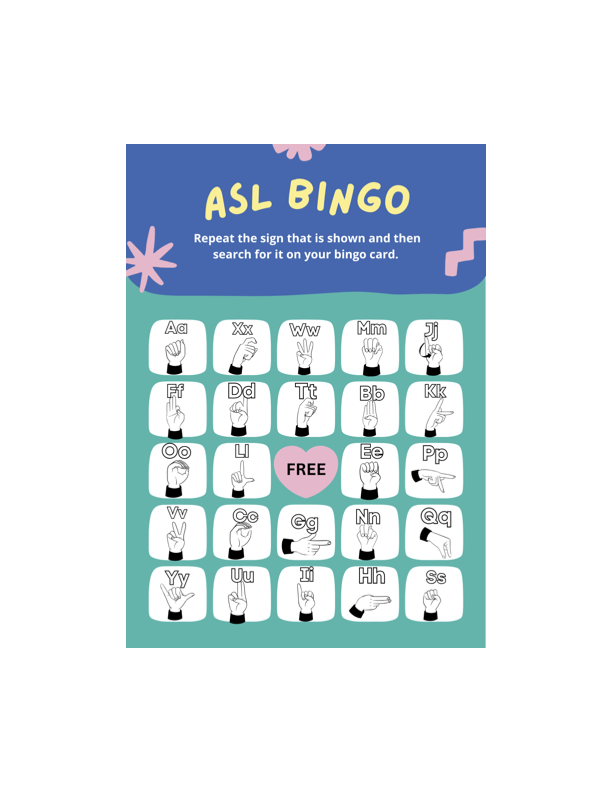
I decided to introduce our ASL Bingo game, and the students absolutely loved it! What I found especially interesting was that even after the game was finished, many students continued showing an interest in learning different words and names in sign language. Our Bingo cards focused specifically on the ASL alphabet, which encouraged students to learn how to fingerspell their own names. By the end of the block, almost every student knew how to sign their first name, and many were asking how to spell their last names as well. This is such a great and simple way to integrate ASL into the classroom while creating a low-pressure environment where students feel comfortable learning and trying something new.
Before introducing the activity, I had to make a few adjustments to our original Bingo cards. I realized that not every card could be the same, and since I couldn’t fit all 26 letters onto each card, some cards contained letters that others did not. I also used an online Bingo number generator and modified how I called out the letters so that it worked with the ASL alphabet while still making the game feel like an official Bingo game.
I chose not to take any pictures during the activity, as some students preferred not to be photographed, and I wanted to respect their privacy and wishes. Although I would have loved to capture some moments from the activity since the students enjoyed it so much. Overall, I found this to be a really rewarding experience. It was exciting to see something my group had created for a university assignment actually being used in a classroom. I was especially happy to see how engaged the students were and how the activity encouraged them to continue learning even after the game had ended. This experience reminded me that learning does not always have to involve traditional lessons or worksheets. Sometimes, a simple game can spark curiosity and encourage them to explore something new on their own. It also connected to my own inquiry project, as I was able to practise my ASL skills while introducing students to a language that I have been learning myself. As a future teacher, I hope to continue creating activities that incorporate ASL. I think that once students have a basic understanding of American Sign Language, it can become easier to integrate it into everyday classroom routines. For example, students could use simple signs to ask questions, request permission to leave the classroom, or communicate basic needs. This would be a great way to encourage students to continue practising ASL naturally throughout the school day while building on what they have already learned.
Here is one of the ASL bingo cards:
Leave a Reply
You must be logged in to post a comment.